
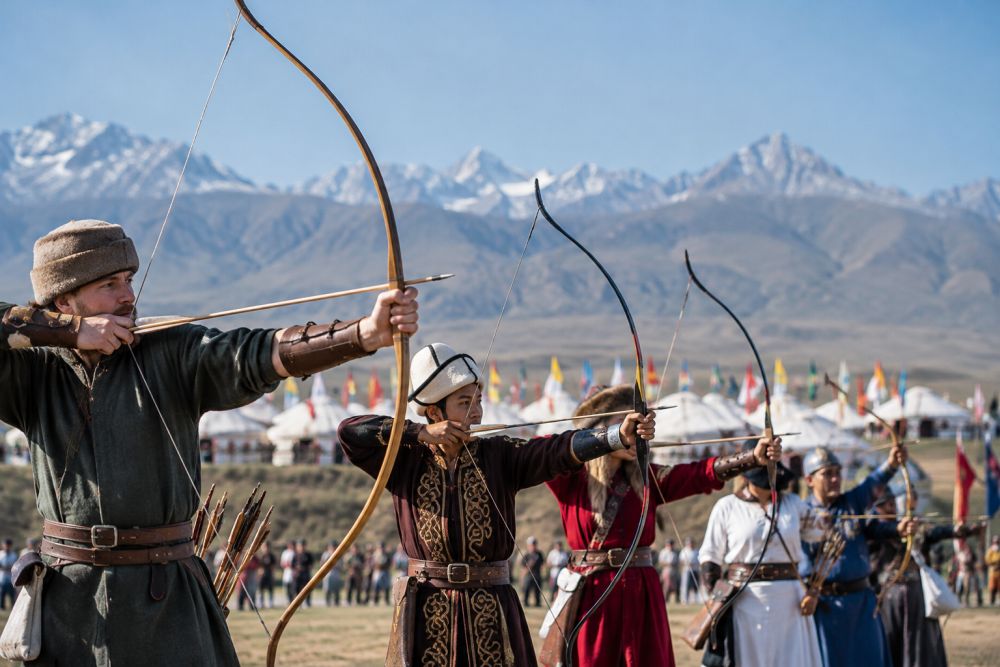
What happens when an archery competition asks competitors not simply to bring a bow, but to bring something of their own culture with it?
At the 2026 World Nomad Games in Kyrgyzstan, more than 250 traditional archers from 51 countries gathered in the Kyrchyn Gorge for three days of competition. But this was not traditional archery reduced to a single international shooting style.
Competitors were required to use a traditional bow associated with their own country, together with wooden arrows, feather fletching and wooden nocks. They also competed wearing traditional national clothing.
That created a shooting line where different archery cultures could remain visibly different rather than being standardised away.
The British delegation, for example, arrived with English longbows — the only competitors using them — while most other nations shot variations of Asiatic bows. Even transporting a two-metre, one-piece wooden longbow to Kyrgyzstan became part of the challenge.
The competition itself moved through three traditions.
The Kyrgyz Teke Buta round was shot at 40 metres and required standing, reversed and kneeling shooting positions. The Turkish Puta event stretched the distance to 60 metres for women and 70 for men. The Korean round moved the targets all the way to 145 metres.
Different equipment. Different distances. Different techniques.
Yet everyone was standing on the same field.
That may be one of the most interesting things about traditional archery internationally. Its value does not come from making every tradition identical. It comes from creating places where those traditions can meet without losing what makes them different.
The World Nomad Games extended far beyond the shooting line. More than 3,000 athletes and delegates from 106 countries took part across 40 sporting disciplines, while the surrounding Kyrchyn Gorge hosted a vast celebration of nomadic culture, crafts, horses and traditional skills.
For the archers, this meant competing inside something larger than a sporting event.
Australian archer Merjem Colan described Ottoman archery as a connection between technical skill, history, character and community. Her observation captures something that statistics and medal tables often miss.
Traditional archery survives because people continue to practise it.
They build the bows, make the arrows, learn the techniques, teach others and carry those traditions into new generations — sometimes thousands of kilometres from where those traditions began.
That is why an event such as the World Nomad Games matters.
Not because every archer shoots the same way.
Because they don't.
The next World Nomad Games are scheduled for Kazan in 2028.