Traditional archery rarely fits neatly into a single set of rules. In Ulsan this week, that diversity is not something to overcome. It is the heart of the competition.
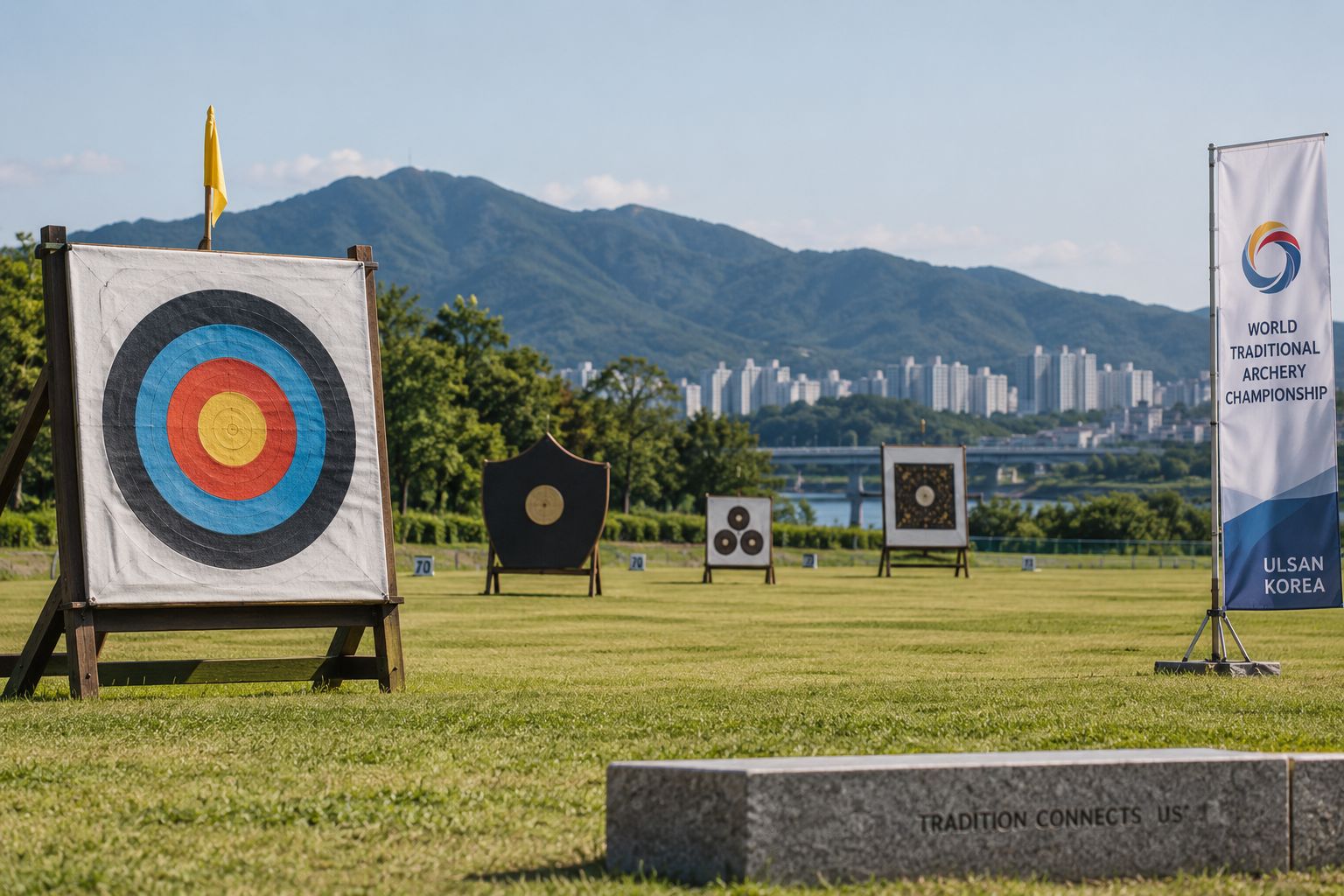
The 2026 Korea Ulsan World Traditional Archery Championship is now underway at the Munsu International Archery Field in South Korea, bringing together 649 athletes from 38 countries. But the scale of the gathering tells only part of the story. What makes Ulsan unusual is the way four very different archery traditions share the same championship.
An archer may face a Korean target at 145 metres, a Hungarian Tarsca shield at 90 metres, the Turkish Puta at 70 metres and the Kazakh Zhamby at 30 metres.
Four distances, four target traditions, and four different pieces of archery culture brought onto one shooting field.
From Korea to Hungary, Türkiye and Kazakhstan
The longest challenge is Korean Kungdo at 145 metres. At that distance, the target may look generous on paper, but the space between archer and target changes everything. Arrow flight, consistency and judgement become part of the challenge in a way that feels very different from shooting at shorter distances.
The Hungarian discipline brings the Tarsca shield target to 90 metres, while the Turkish Puta is shot at 70 metres. At 30 metres, competitors meet the Kazakh Zhamby.
Together they make the championship something more interesting than a conventional tournament built around one standardised target.
An archer who feels at home in one discipline must adapt to another. The bow remains familiar, but the distance, target and tradition change.
The competition is now taking shape
After practice and the opening ceremony on 30 October, qualification began with the 30-metre and 145-metre disciplines.
Today, 1 November, the focus moves to the 70-metre Turkish Puta alongside another group shooting the 145-metre Korean discipline. On 2 November, the Hungarian Tarsca takes its turn at 90 metres while the remaining Kungdo qualification continues.
The best archers then move into the knockout stages on 3 November, from the Round of 16 through the semifinals. Medal matches and finals across all four disciplines follow on 4 November.
By then there will be champions and rankings. But those results are only one part of what is happening in Ulsan.
A meeting of living traditions
Traditional archery is sometimes spoken about as though it were one discipline. Events such as Ulsan show why that description is too simple.
Korean, Hungarian, Turkish and Kazakh archery developed in different places, for different purposes and within different cultures. Their bows, shooting traditions and targets carry those histories with them.
Putting them together does not erase those differences. It makes them visible.
An archer standing on the line in Ulsan is not simply moving from 30 metres to 70, 90 or 145. Each change of target introduces another tradition and another way of understanding what archery can be.
That may ultimately be the most interesting part of this championship.
For several days in South Korea, hundreds of archers from around the world are not being asked to practise one universal version of traditional archery.
They are being asked to meet several traditions on their own terms.
And that feels like a fitting way to celebrate a sport whose history has never belonged to just one place.
The 2026 Korea Ulsan World Traditional Archery Championship continues until 4 November, when the finals and award ceremony will conclude the competition.